
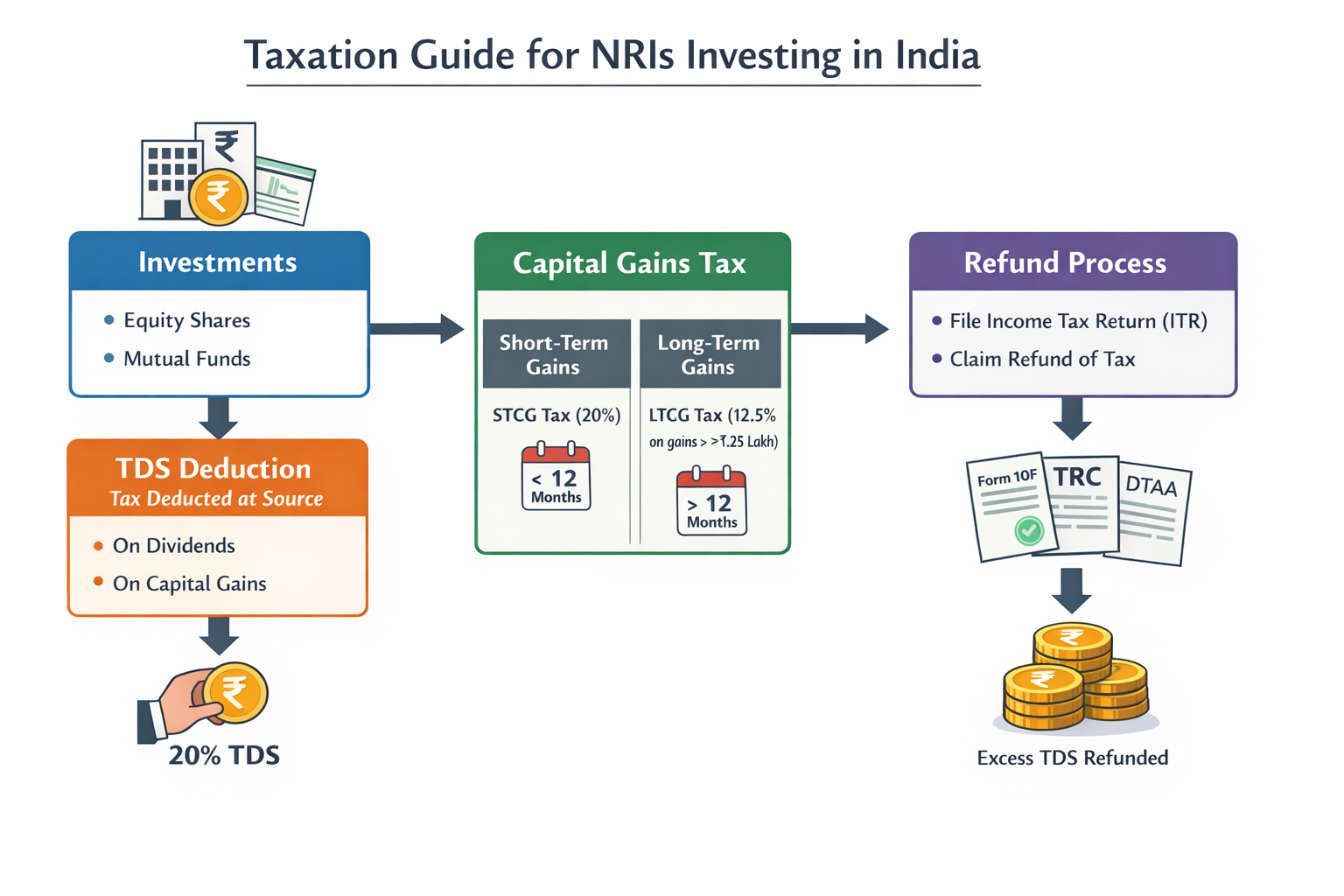
Indian mutual funds and equity markets present lucrative investment opportunities for Non-Resident Indians (NRIs). However, income taxation rules for NRIs differ significantly from residents, and understanding these provisions is essential to optimize returns. Mandatory TDS, capital gains tax, and other tax income implications directly affect profitability. This guide covers the taxation of shares and mutual funds for NRIs, including income tax, capital gains tax, dividend taxation, and claiming refunds.
Can NRIs Invest in Indian Mutual Funds and Shares?
Yes, NRIs are permitted to invest in Indian capital markets subject to FEMA regulations. Such investments must be routed through NRE or NRO bank accounts
Explanation of Key Terms:
| Term | Definition |
| NRI | Individual classified as non-resident under the Income Tax Act, 1961. |
| Capital Gains | Profit from sale or redemption of shares or mutual fund units. |
| Mutual Funds | Pooled investment vehicle in equities, bonds, or securities. |
| Shares | Units of ownership in a company entitling the investor to profits and assets. |
| DTAA | tax treaty signed between two or more countries to prevent the same income from being taxed in both countries. |
Key Requirements for Investments in:
| Investment Type | Key Requirements for NRIs | Purpose / Benefit |
| Mutual Funds | – NRI status, -NRE/NRO account, – KYC, -correct investment method ((direct or via PoA)) | Ensures proper taxation of capital gains and compliance with income taxation rules |
| Shares | – PIS Account – Demat/Trading account – Delivery-based investing (intraday restricted) | Accurate tax income reporting and eligibility for refund tax if excess TDS is deducted |
Tax on Equity Shares for NRIs in India
For NRIs, income tax on Indian shares and mutual funds depends on the holding period, which determines capital gains tax treatment, while TDS and DTAA provisions affect tax income and refund tax eligibility.
Capital Gains Tax on Equity Shares (NRIs)
| Type of Gain | Holding Period (Listed Shares) | Tax Rate | TDS Rate |
| STCG | Up to 12 months | 20% | 20% |
| LTCG | More than 12 months | 12.5% on gains above ₹1.25 lakh | 12.5% |
*Surcharge (max 15%) and 4% Health & Education Cess apply.
Capital Gains Tax on Mutual Funds (NRIs)
| Fund Type | Holding Period | Classification | Tax Rate for NRIs (plus surcharge & cess) | TDS Rate |
| Equity-Oriented (>65% equity) | Short-term (<12 months) | STCG (Short-Term Capital Gains) | 20% (effective July 23, 2024; previously 15%) | 20% |
| Equity-Oriented (>65% equity) | Long-term (>12 months) | LTCG (Long-Term Capital Gains) | 12.5% on gains exceeding ₹1.25 lakh annually (effective July 23, 2024; previously ₹1 lakh) | 12.5% |
| Debt & Other (<65% equity) | Short-term (<24 months) | STCG | As per applicable income tax slab rates (up to 30%) | 30% |
| Debt & Other (<65% equity) | Long-term (>24 months) | LTCG | 12.5% (without indexation, effective July 23, 2024) | 12.5% |
*Debt fund units purchased after April 1, 2023, are taxed as short-term at slab rates.
Other Key Income Tax Provisions
- TDS on redemption/dividends; excess can be claimed as refund tax via income tax return.
- Dividend income taxed at slab rates; 20% TDS applies.
- DTAA benefits.
This structured approach helps NRIs manage tax income efficiently under Indian income tax laws.
How NRIs Can Claim DTAA Benefits:
NRIs can claim DTAA benefits, including reduced withholding rates, tax credits, and exemptions, by confirming non-resident status, obtaining a TRC, submitting Form 10F if needed, providing PAN/passport, and filing an Indian tax return for income reporting or refunds. NRIs from Few Countries like UAE and Singapore can potentially pay zero capital gains tax on their Indian mutual fund gains with double taxation avoidance tax treaty provision.
Is Filing Income Tax Return Mandatory for NRIs?
Filing an ITR in India becomes necessary when:
- Total income exceeds the basic exemption limit
- Sale of mutual funds/shares
- Excess TDS has been deducted and refund is claimed
- DTAA benefits are to be availed
Conclusion
Indian mutual funds and shares are lucrative for NRIs, but strict TDS, capital gains, and DTAA rules affect returns; understanding these helps plan investments, claim refunds, and stay compliant.